OEM vs ODM Ceramic Dinnerware: Which Model Fits Your Market?
January 12, 2024
OEM vs ODM Ceramic Dinnerware: Which Model Fits Your Market?
OEM vs ODM Ceramic Dinnerware:
Which Model Fits Your Market Better?
Hi, I’m Alisa.
I’ve been working in the ceramic dinnerware industry for 8 years, and I’m currently responsible for marketing and customer coordination at CY Ceramic Factory. Almost every day, clients ask me the same question:
“Should we choose OEM or ODM for our ceramic dinnerware?”
Today, instead of giving you textbook definitions, I’d like to share some real, practical insights—from someone inside the industry—just like a conversation between friends. Hopefully, this helps you find the path that fits your market best.
1. Understanding the Basics: What Are OEM and ODM?
Let me explain this with a simple analogy.
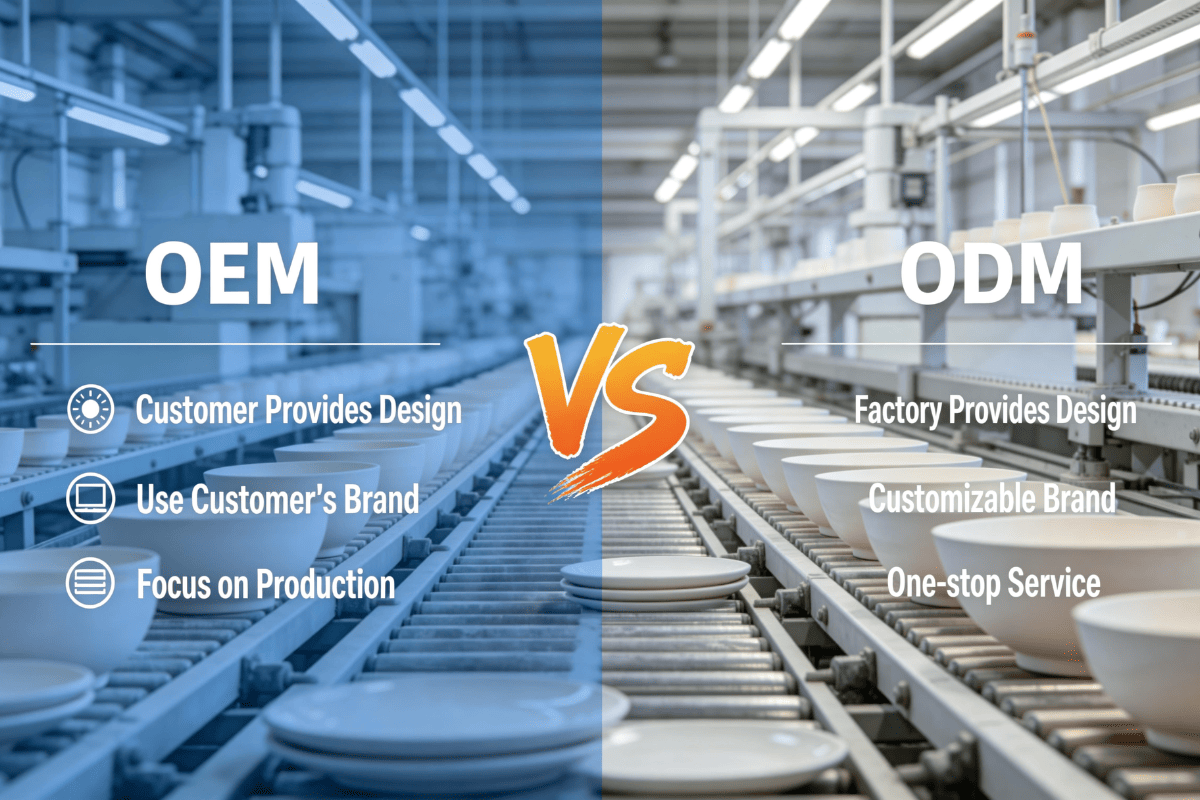
OEM (Original Equipment Manufacturing)
Think of it like bringing a detailed recipe to a chef. You already know exactly what dish you want. You control the design and branding, and I simply follow your instructions to produce it.
You own the design and the brand.
The factory focuses purely on manufacturing.
ODM (Original Design Manufacturing)
This is more like telling me:
“Alisa, I’m looking for a dinnerware collection suitable for Nordic-style restaurants, within a certain budget.”
From there, my team handles everything—from design concepts and sampling to production—offering you complete, ready-to-use solutions. In this case, both design and manufacturing are led by the factory.
2. How to Choose? It Depends on Your Business DNA and Stage
When OEM Makes More Sense
OEM may be the right choice if you:
Have an established brand and clear designs
Your brand already has a defined visual identity and product direction. What you need is a reliable factory to turn your ideas into reality.Require strict control over materials and processes
You want to specify clay composition, glaze formulas, decal techniques, and cost structures down to the smallest detail.Value uniqueness and design confidentiality
Your designs are core assets, and you don’t want similar products appearing elsewhere in the market.
Our strength in OEM at CY Ceramic Factory:
We specialize in accurate execution. With 8 years of production experience, we help clients solve the technical challenges between drawings and finished products, ensuring the final result matches the original concept as closely as possible.
When ODM Can Be a Powerful Accelerator
ODM may be your best ally if you:
Are a startup brand or expanding product lines quickly
You may not have a full design team, but you need competitive products to test the market efficiently.Care about speed and market trends
Trends like “dopamine colors,” “modern oriental,” or minimalist matte glazes move fast. ODM allows you to adopt mature, market-tested designs without long development cycles.Want to control upfront investment
Independent product development takes time and money. ODM lets you share the factory’s design resources and market insights, reducing trial-and-error costs.
Our strength in ODM at CY Ceramic Factory:
We closely track trends in Europe, Japan, Korea, and domestic markets, developing new collections every year. For example, we anticipated the rise of matte glazes last year, and those early-developed series later became best-sellers for many of our clients.
3. The Core Question: What Does Your Market Really Need?
Here are a few ways to judge:
Look at your customer base
If your customers buy your brand identity and unique designs—such as high-end gifts or designer brands—OEM should be your foundation.
If they care more about trendy styles and price competitiveness—such as fast-moving homeware or e-commerce products—ODM helps you respond faster.
Calculate your time cost
Do you have enough time for full in-house development from concept to mass production? If market opportunities are short-lived, ODM’s “plug-and-play” approach can be more practical.
Evaluate your internal team
OEM requires strong design, quality control, and supply chain management on your side. If your team is limited, working with a reliable ODM partner allows you to focus more on branding and sales.
4. My Honest Take After 8 Years
In recent years, I’ve seen more clients adopt a hybrid OEM + ODM strategy:
Core product lines use OEM to preserve brand DNA
Seasonal or experimental products use ODM for speed and flexibility
In many cases, this combination turns out to be the most efficient approach.
No matter which model you choose, the key is finding a factory that truly understands your needs, communicates clearly, and has solid technical capability. A good partnership isn’t just about buying and selling—it’s about growing together with trust.
I hope these insights help.
If you’re still deciding or want to explore details specific to your market, feel free to reach out. Sometimes, a simple conversation can bring real clarity.
I wish your brand every success—whichever path you choose.