
How to Maintain Dimensional Consistency of Hotel Tableware
December 09, 2023
How to Maintain Dimensional Consistency of Hotel Tableware
This article is not written for retail consumers or household users.It is intended for professionals involved in hotel projects, bulk tableware procurement, and long-term supply contracts.
From our experience in hotel projects, one of the most common misconceptions is the idea that hotel tableware is simply a “stronger version” of household tableware.
In reality, this assumption is far from accurate. So what defines a truly qualified product for hotel use?
In hotel projects, a good tableware product must meet three basic requirements.
First, it must withstand high-frequency dishwashing over a long period of time.
Second, it should remain free from visible scratches even after repeated stacking and daily handling.
Third—and this point is often underestimated—the quality of replenishment orders must remain highly consistent with the original batch.
Interestingly, problems with hotel tableware rarely appear at the time of delivery. They usually emerge two or three months later, after the products have already entered real daily use.
One of the most common issues is inconsistent dimensions.When plates are packed in cartons and separated by pearl cotton or paper layers, it is almost impossible to detect dimensional inconsistencies. Everything looks fine on the surface. However, once the plates are taken out of the dishwasher and stacked in large quantities in a real hotel environment, dimensional differences become immediately obvious.
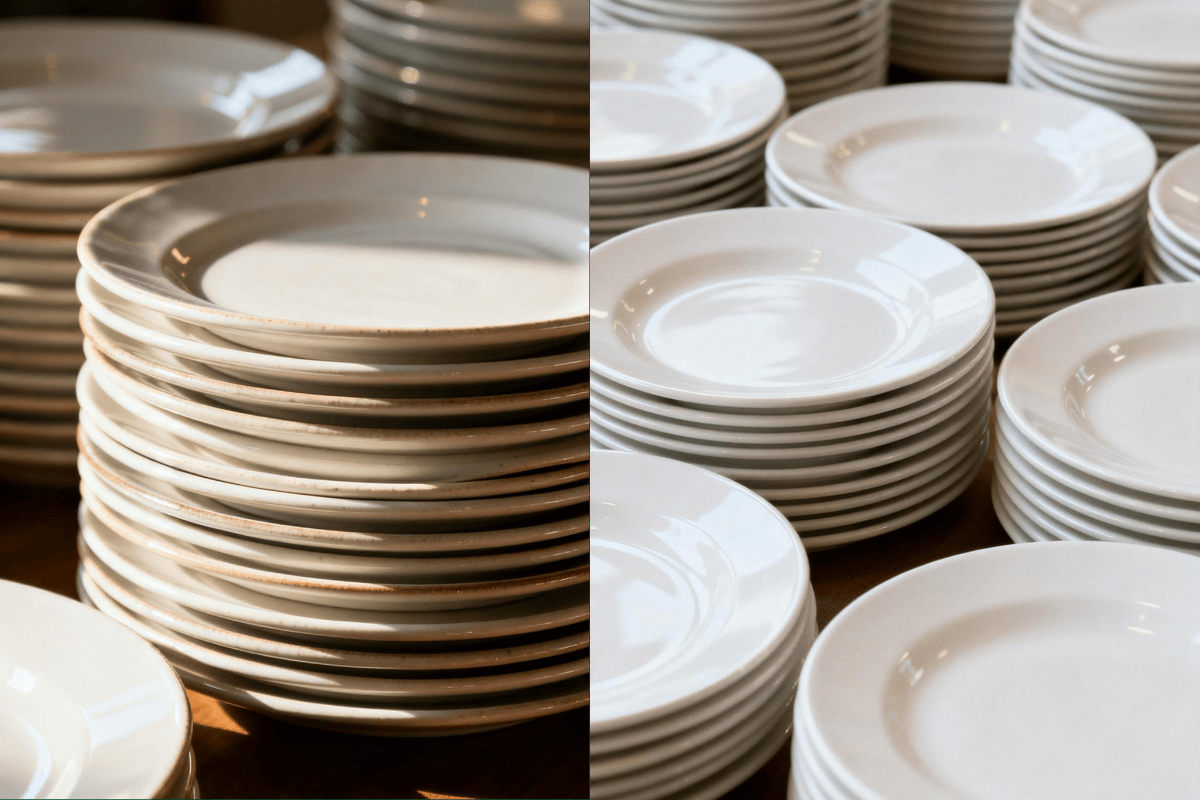
At that point, customers may not file a formal complaint, but they will certainly feel dissatisfied with the unstable stacking performance—and this dissatisfaction directly affects their confidence in the supplier.
So how can this issue be avoided? And what should buyers pay attention to when selecting a manufacturer?
1. Mold wear and mold management
One common cause of dimensional inconsistency is mold wear. Once a mold exceeds acceptable tolerance limits, it must be repaired or replaced. This is why a proper mold management system is critical. Without it, dimensional deviations will gradually accumulate without being noticed.
2. Post-kiln inspection is not a real solution
Screening products after firing can help remove defective pieces, but this is essentially a remedial measure, not a fundamental solution. In hotel projects, prevention is always far more effective—and less costly—than correction.
3. The forming process makes a decisive difference
The most important factor affecting dimensional consistency is the forming method itself—whether production relies on semi-automatic manual forming or fully automated machinery.
Many small workshops cannot afford fully automated equipment and therefore rely on semi-automatic pressing with manual intervention. This difference has a direct and measurable impact on consistency.
a. Fully automated forming
With fully automated equipment, parameters such as pressure, speed, stroke, mold height, cutter depth, and forming time are all preset and locked into the system. Human intervention is minimal. Under stable conditions, plate diameter deviations are typically controlled within 1–1.5 mm, and depth deviations are usually around 1 mm. These tolerances are small enough that they do not affect stacking performance in real use.
b. Semi-automatic forming
In semi-automatic production, manual operation plays a much larger role. Differences in pressing force and timing lead to wider dimensional variations. Plate diameter deviations can increase to 2–3 mm, while depth differences may reach 2 mm or more. Issues such as uneven rims and inconsistent wall thickness also become more common.
This problem is particularly noticeable with Western-style hotel tableware, such as salad plates and flat dinner plates. Compared with deeper plates, flat designs tend to amplify even small dimensional errors.
4. Pre-kiln dimensional inspection is a key indicator of factory professionalism
Well-established factories usually perform pre-kiln dimensional checks. After forming, they measure the dimensions of wet blanks before sending them to the kiln. This allows them to identify mold wear and forming deviations at an early stage, significantly reducing defect rates and ensuring better consistency across large batches.
5. Firing consistency is essential for dimensional stability
The firing process also plays a critical role in dimensional control. Every batch must follow the same firing program, including heating speed, soaking time, and cooling schedule. Products belonging to the same order should be placed in the same temperature zone within the kiln. Mixing products between high-temperature areas and colder zones will inevitably lead to inconsistent shrinkage.
All firing parameters should be carefully recorded. This documentation ensures that when replenishment orders are placed in the future, the exact same firing conditions can be replicated. Consistency in ceramic body clay composition is equally important and should never be overlooked.
6. Kiln type also matters
Kilns are generally divided into tunnel kilns and shuttle kilns. For hotel tableware projects, tunnel kilns are usually the preferred option, as they offer more stable and repeatable firing conditions over long production cycles.
If you would like to learn more about the differences between tunnel kilns and shuttle kilns, please refer to our dedicated article on this topic.
The Difference Between Shuttle Kilns and Tunnel Kilns and Their Impact on Ceramic Forming
Explore more related articles:
• Glaze Quality and Color Stability in Hotel Projects